Audit of the Federal Reserve Reveals $16 Trillion in Secret Bailouts

The first ever GAO (Government Accountability Office) audit of the Federal Reserve was carried out in the past few months due to the Ron Paul, Alan Grayson Amendment to the Dodd-Frank bill, which passed last year. Jim DeMint, a Republican Senator, and Bernie Sanders, an independent Senator, led the charge for a Federal Reserve audit in the Senate, but watered down the original language of the house bill(HR1207), so that a complete audit would not be carried out. 
Bernanke

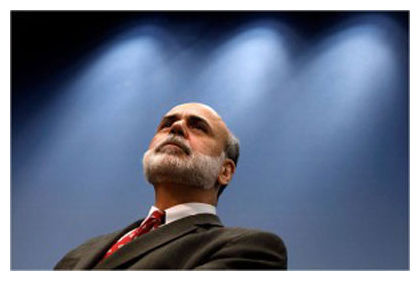
Ben Bernanke (pictured to the right), Alan Greenspan, and various other bankers vehemently opposed the audit and lied to Congress about the effects an audit would have on markets. Nevertheless, the results of the first audit in the Federal Reserve's nearly 100 year history were posted on Senator Sander's webpage earlier this morning.

Researchers engineer light-activated skeletal muscle


Print


Many robotic designs take nature as their muse: sticking to walls like geckos, swimming through water like tuna, sprinting across terrain like cheetahs. Such designs borrow properties from nature, using engineered materials and hardware to mimic animals’ behavior.

Now, scientists at MIT and the University of Pennsylvania are taking more than inspiration from nature — they’re taking ingredients. The group has genetically engineered muscle cells to flex in response to light, and is using the light-sensitive tissue to build highly articulated robots. This “bio-integrated” approach, as they call it, may one day enable robotic animals that move with the strength and flexibility of their living counterparts. 

The researchers’ approach will appear in the journal Lab on a Chip.

Harry Asada, the Ford Professor of Engineering in MIT’s Department of Mechanical Engineering, says the group’s design effectively blurs the boundary between nature and machines. 

“With bio-inspired designs, biology is a metaphor, and robotics is the tool to make it happen,” says Asada, who is a co-author on the paper. “With bio-integrated designs, biology provides the materials, not just the metaphor. This is a new direction we’re pushing in biorobotics.”

Occupy Wall Street plans 'people's wall' outside NY Stock Exchange for anniversary

New York Stock Exchange.(AFP Photo / Spencer Platt)

Occupy Wall Street will turn one year old in a few weeks, and organizers with the group want to make sure the movement's first anniversary won't be forgotten. To commemorate, OWS plans on staging a mass protest outside the New York Stock Exchange.

Organizers with Occupy, a protest movement formed last year to address issues of corporate greed and big businesses’ relationship with politics, are asking supporters to participate in a mass sit-in outside the NYSE when their first birthday comes around next month on September 17.

"There'll be a mass of people converging on the Stock Exchange to deliver our message: that we're the 99 percent and we're not going to take it,” OWS organizer Dana Balicki tells AFP.

The spokesperson with the group says that Occupy hopes to erect a massive “people’s wall” outside the NYSE.

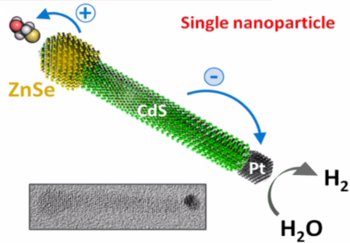
Novel Technique to Synthesize Nanocrystals That Harvest Solar Energy

One reason that solar energy has not been widely adopted is because light absorbing materials are not durable. Materials that harvest solar radiation for energy often overheat or degrade over time; this reduces their viability to compete with other renewable energy sources like wind or hydroelectric generators. A new video protocol addresses these issues by presenting a synthesis of two inorganic nanocrystals, each of which is more durable than their organic counterparts. The article, published inJournal of Visualized Experiments (JoVE), focuses on the liquid phase synthesis of two nanocrystals that produce hydrogen gas or an electric charge when exposed to light. "The main advantage of this technique is that it allows for direct, all inorganic coupling of the light absorber and the catalyst," says the leading author Dr. Mikhail Zamkov of Bowling Green State University.

Survey: 75% of Homeless Youth Use at Least One Social Network

In a small but intriguing study, social scientists found that 75 percent of the homeless youth they surveyed use social networks and that their usage patterns were remarkably similar to college students. 

Led by the University of Alabama's Rosanna Guadagno, they surveyed 237 college kids and 65 homeless youth, both with an average age of a little over 19 years old. While a greater percentage of the students were on social networks (over 90 percent), both groups of users reported spending more than an hour per day using Facebook, Twitter, and the like. 

Guadagno argues that the results should lead us to rethink the concept of the digital divide of Internet haves and have nots. "To the extent that our findings show a 'digital divide' between undergraduates at a four-year university and age-matched participants in a program for homeless young adults, it is mainly in types of Internet use and not access to the Internet, and that divide is relatively minor," we read. "Since it is clear that the proportions of undergraduates and homeless young adults accessing social networking sites are similar, we assert that the term digital divide is not descriptive of the young adult population."

Up ↑