TOKYO -- Forget 3D TV, Japan is promoting the idea of ultra-realistic holographic broadcasts and the ability to zoom a virtual camera in behind players on the pitch if it secures the 2022 World Cup. Japan proposes expanding the World Cup to all 208 FIFA member nations through fan-fest events that will feature live, holographic coverage of the games. Fans will gather in stadiums thousands of kilometers from the action and watch the games as if they are taking place in front of their eyes.
Thermoelectric material is world's best at converting heat waste to electricity
The material could signify a paradigm shift. The inefficiency of current thermoelectric materials has limited their commercial use. Now, with a very environmentally stable material that is expected to convert 15 to 20 percent of waste heat to useful electricity, thermoelectrics could see more widespread adoption by industry. Possible areas of application include the automobile industry (much of gasoline's potential energy goes out a vehicle's tailpipe), heavy manufacturing industries (such as glass and brick making, refineries, coal- and gas-fired power plants) and places were large combustion engines operate continuously (such as in large ships and tankers). Waste heat temperatures in these areas can range from 400 to 600 degrees Celsius (750 to 1,100 degrees Fahrenheit), the sweet spot for thermoelectrics use. The new material, based on the common semiconductor lead telluride, is the most efficient thermoelectric material known. It exhibits a thermoelectric figure of merit (so-called "ZT") of 2.2, the highest reported to date. Chemists, physicists, material scientists and mechanical engineers at Northwestern and Michigan State University collaborated to develop the material. The study will be published Sept. 20 by the journal Nature. "Our system is the top-performing thermoelectric system at any temperature," said Mercouri G. Kanatzidis, who led the research and is a senior author of the paper. "The material can convert heat to electricity at the highest possible efficiency. At this level, there are realistic prospects for recovering high-temperature waste heat and turning it into useful energy."
Thermoelectric material is world’s best at converting heat waste to electricity
The Largest Vertical Garden in the World
Located in Rozzano, Italy, the vertical garden at the Fiordaliso Shopping Center was recognized this week by the Guiness World Records as the largest vertical garden in the world.
Covering a surface of 1,263 square meters (13,594 square feet) with a total of 44,000 plants, the massive vertical garden surpassed the former record-holder, a vertical garden in Madrid that covered 844 square meters (9,085 sq ft).
The garden was innaugurated in 2010 and was designed by architect Francesco Bollani, who remarked, “it took us a year to grow the plants in a greenhouse and 90 days to build the facade. It was like building a giant Lego!”
The garden, which uses small metallic containers and no soil, cost approximately $1.3 million to build.
The Largest Vertical Garden in the World
Democrats Continue to Boost U.S. Economic Confidence
Democrats and, to a lesser degree, independents continue to buoy U.S. economic confidence in September. These groups' confidence rose sharply in early September, coinciding with the first day of the Democratic National Convention on Sept. 4, and remained elevated last week. At the same time, at -55, Republicans' overall confidence in the economy remains about as low as it has been since late June.

As a result of these partisan patterns, the overall Gallup Economic Confidence Index is holding steady near the highest level seen this year. The index averaged -19 for the week ending Sept. 16, after surging 11 points the week prior to -18.
Democrats Continue to Boost U.S. Economic Confidence


30 Major Corporations Paid No Income Taxes In The Last Three Years, While Making $160 Billion

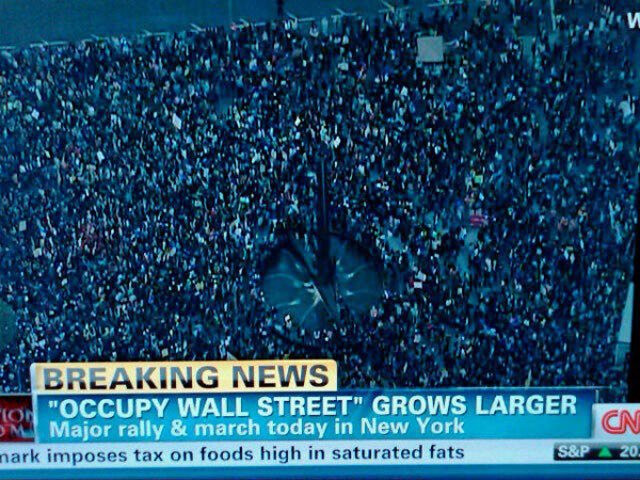
One of the driving forces behind the ongoing Occupy Wall Street protests is the fact that corporations have not been paying their fair share in taxes. A new report from Citizens for Tax Justice will no nothing to alleviate the protesters’ frustration.
CTJ looked at 280 companies, all of them members of the Fortune 500, and found that “while the federal corporate tax code ostensibly requires big corporations to pay a 35 percent corporate income tax rate, on average, the 280 corporations in our study paid only about half that amount.” And those who paid even half the statutory corporate tax rate paid far more than many of their competitors.
In fact, in the last three years, 78 corporations had at least one year where they paid no federal income tax at all, while 30 corporations paid not a dime over the entire three years. Those 30 corporations paid nothing, even though they made $160 billion in profits over that period:
– Seventy-eight of the 280 companies paid zero or less in federal income taxes in at least one year from 2008 to 2010…In the years they paid no income tax, these companies earned $156 billion in pretax U.S. profits. But instead of paying $55 billion in income taxes as the 35 percent corporate tax rate seems to require, these companies generated so many excess tax breaks that they reported negative taxes (often receiving outright tax rebate checks from the U.S. Treasury), totaling $21.8 billion. These companies’ “negative tax rates” mean that they made more after taxes than before taxes in those no-tax years.
– Thirty corporations paid less than nothing in aggregate federal income taxes over the entire 2008-10 period. These companies, whose pretax U.S. profits totaled $160 billion over the three years, included: Pepco Holdings (–57.6% tax rate), General Electric (–45.3%), DuPont (–3.4%), Verizon (–2.9%), Boeing (–1.8%), Wells Fargo (–1.4%) and Honeywell (–0.7%).

As CTJ’s report put it, “just as workers pay their fair share of taxes on their earnings, so should successful businesses pay their fair share on their success. But today corporate tax loopholes are so out of control that most Americans can rightfully complain, ‘I pay more federal income taxes than General Electric, Boeing, DuPont, Wells Fargo, Verizon, etc., etc., all put together.’ That’s an unacceptable situation.” And its one that lawmakers could fix, if they were willing to stand up to the nation’s biggest corporations.
30 Major Corporations Paid No Income Taxes In The Last Three Years, While Making $160 Billion

The current view of the 2012 presidential election.
Our snapshot of where the presidential race stands is based on hundreds of state-wide and national opinion polls — filtered through a poll-tracking model — and updated throughout the day.
The current view of the 2012 presidential election.
U.S. Unadjusted Unemployment Rate at 7.9% in Mid-September
U.S. unemployment, as measured by Gallup without seasonal adjustment, is 7.9% in mid-September, down 0.2 percentage points from August and a new low since Gallup began collecting employment data in January 2010. Gallup's seasonally adjusted unemployment rate remains unchanged at 8.1% in mid-September.

These results are based on Gallup Daily tracking surveys conducted by landline and cell phone from Aug. 16-Sept. 15, including interviews with more than 30,000 U.S. adults -- 68.1% of whom are active in the workforce. Gallup's seasonally adjusted unemployment rate incorporates the 0.2 upward adjustment used by the U.S. Bureau of Labor Statistics in September of last year.
The mid-September unadjusted unemployment estimate, if sustained throughout the rest of the month, would be the lowest monthly unadjusted rate since Gallup began tracking unemployment daily in January 2010. Gallup's unadjusted unemployment rate for September 2011 was substantially higher than now at 8.6%.
Fewer Part-Time Workers Seeking Full-Time Work
The percentage of Americans working part time but looking for full-time work is 8.6% in mid-September, as measured without seasonal adjustment, down from the 9.0% in August. This is also down from 9.7% a year ago and the lowest level for this measure since the 8.4% of November 2010.

Underemployment Down From a Year Ago and at a New Low
Gallup's U.S. underemployment measure, which combines the unemployed with those working part time but looking for full-time work, is 16.6% in mid-September, down from 17.1% in August. The underemployment rate is also down substantially from 18.3% last September and is at its lowest level since January 2010.

Implications
While unadjusted unemployment has improved so far in September, at least part of the improvement is likely due to a seasonal increase in hiring related to Halloween -- which is now a major sales period for the nation's retailers. In fact, the 0.2 seasonal adjustment that the government applied in September 2011 would suggest virtually all the improvement is seasonally related. Further, Gallup's unadjusted unemployment rate has remained between 7.9% and 8.2% since May -- implying a relatively flat job market. Still, the mid-September unadjusted unemployment rate, if maintained for the remainder of the month, is at a new low and is substantially below the 8.6% of a year ago.
It is also worth noting that the percentage of those working part-time but wanting full-time work is near the 8.4% low for this measure. As a result, the underemployment rate is at a new low. This is often seen as a good sign for the U. S. economy because it implies more part-time workers are getting full-time jobs.
Gallup's mid-September adjusted unemployment rate data suggest the BLS will announce no change in the government's seasonally adjusted unemployment rate for September in its early October reports. This seems consistent with the overall modest improvement in the job market over the past year and what appears to be a muddle-through economy in 2012.
U.S. Unadjusted Unemployment Rate at 7.9% in Mid-September
Cooperation Theory and Practice
I see a new story emerging about how humans get things done together. The outlines of this new narrative can be seen in recent evidence that contradicts old assumptions about human selfishness versus altruism, self-interest versus collective action. What could be more important than understanding how people cooperate and fail to cooperate? Problems and challenges in everyday life in the home, office, factory, public places and global behavior such as conflict, pollution, resource sustainability are all being addressed with very little comprehensive knowledge about cooperation. Before empirical biology, people thought disease was caused by foreigners, witches, or sin. With the advent of experimental science and the invention of the microscope, we understood that microorganisms in water and food were killing our children. In regard to cooperation theory, fragmentary and specialized knowledge is advancing in a dozen or more different fields, but in terms of putting this fragmented knowledge together into a systemic whole, we’re still in the pre-microscope era.

