Hulu
Mosh: An Interactive Remote Shell for Mobile Clients
Mosh (http://mosh.mit.edu) is a remote terminal application that supports intermittent connectivity, allows roaming, and speculatively and safely echoes user keystrokes for better interactive response over high-latency paths.
Mapping Inside Buildings By Tracking Earth's Magnetic Field
The kind of accurate geolocation offered by Global Positioning Systems has typically been difficult to apply indoors because metallic structures like buildings disrupt the Earth’s magnetic field, rendering compasses like the one found in many smartphones useless when inside. So map- and app-maker IndoorAtlas decided to spin these magnetic disturbances into something useful. Via an upcoming smartphone app, the company has created a way for users to navigate indoorsusing those very magnetic disturbances as their guide.
It works fairly simply (you can see just how simply in the video below). A map maker--which can be anyone, really--takes a building’s blueprint or floorplan and imposes it on a traditional map, like a Google Maps satellite image. Then the mapmaker simply walks along the passageways inside the building with smartphone in hand to chart the magnetic variations within the building as he or she goes. This magnetic map is then uploaded to IndoorAtlas’s database.
Once the map is made, visitors to the building can download the map to their phones and use it to navigate the floorplan of the building. Unlike other proposed indoor navigation systems thatwe’ve written about previoulsy, it doesn’t require any additional hardware to be installed in the building, like Bluetooth nodes or Wi-Fi. And because virtually anyone with access to a floorplan can be a mapmaker, the potential for the number of available maps to proliferate quickly is high. A visual explainer is below.
Mapping Inside Buildings By Tracking Earth’s Magnetic Field
WebRTC is a free, open project that enables web browsers with Real-Time Communications (RTC) capabilities via simple Javascript APIs. The WebRTC components have been optimized to best serve this purpose.
Our mission: To enable rich, high quality, RTC applications to be developed in the browser via simple Javascript APIs and HTML5.
Our current milestone: To iterate on our first implementation and use web developer feedback to improve the WebRTC API.
The WebRTC initiative is a project supported by Google, Mozilla and Opera. This website and its content is created and maintained by the Google Chrome team.
WebRTC
What is ETT?
ETT stands for Evacuated Tube Transport. ETT is the fastest and most efficient way to travel. It uses well known methods, parts, and technologies. The patented system works by eliminating virtually all friction normally associated with travel. Three basic embodiments range from: low tech low speed systems for local use at speeds below 200 mph; to high tech systems for continental and intercontinental transport up to 4,000 mph or more. For greater detail see technology section.
Who can use ETT?
Just like trains, initial ETT use will be for cargo, and along high use routes of travel.
Once proven, construction will rapidly spread. Since the system is efficient in energy and materials use, high-speed travel will be low cost, and sustainable. Eventually, everyone in the world may use the system.
Who's going to operate ETT?
For fiscal operation, both corporate and public operation is encouraged by the non-exclusive, low cost licensing plan. The license promotes both cooperation and competition.
Physical operation of the system is by automated computer control. The only input and skills required are the ability to chose and enter a destination.
ET3
Libor Scandal: As New York Fed Chief, Timothy Geithner Had Multiple Meetings With Barclays

As president of the New York Federal Reserve before and during the financial crisis, Treasury Secretary Timothy Geithner met repeatedly with Barclays officials, according to documents released by the bank and the New York Fed.
Though the subject of those discussions is unknown, they came at a time when Barclays was also talking to New York Fed officials about problems with an interest rate known as Libor, some five years before the bank agreed to pay $450 million to settle charges that it manipulated that interest rate.
The meetings raise questions about just how much Geithner, now the U.S. Treasury secretary, knew about the alleged manipulation of Libor, a critical interest rate that affects borrowing costs throughout the economy -- questions he'll have to answer at a Senate hearing later this month. They could also renew criticisms of Geithner as being too chummy with the banking sector he was charged with regulating in his role at the Fed.
According to The Huffington Post's review of Geithner's calendar during his time at the New York Fed, originally obtained by The New York Times, Geithner repeatedly spoke from April 2007 to October 2008 with senior executives at Barclays, including at an Oct. 10, 2008, morning meeting with Bob Diamond, the former Barclays CEO, who stepped down last week amid the ballooning Libor controversy.
Libor Scandal: As New York Fed Chief, Timothy Geithner Had Multiple Meetings With Barclays
Dark Galaxies Discovered—May Be Cosmic "Missing Links"

Quasar HE0109-3518 (red circle) illuminates dark galaxies (blue circles).
Dark Galaxies Discovered—May Be Cosmic “Missing Links”
Gallup Poll Finds Confidence In TV News Has Hit A New Low
Confidence in television news has hit a new low, a new Gallup poll reported Tuesday.
The polling firm does an annual survey of the confidence that Americans have in their biggest institutions. Gallup noted that its survey took place before CNN and Fox Newsbotched the Supreme Court's ruling on President Obama's health care law, presumably as a way to emphasize just how little faith people seem to have in their newscasts.
Just 21% of adults said they had a "great deal" or "quite a lot" of confidence in TV news. That's down a whopping 25% from 1993, when Gallup began the poll:
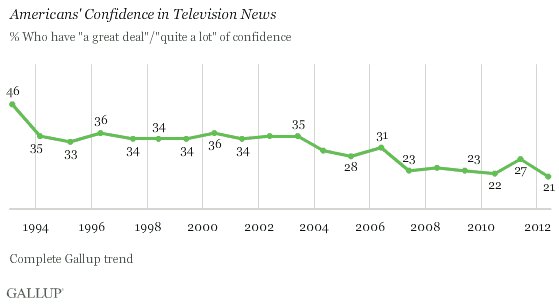
Gallup Poll Finds Confidence In TV News Has Hit A New Low
A Global Perspective on Happiness and Fertility
The literature on fertility and happiness has neglected comparative analysis. we investigate the fertility/happiness association using data from the world values Surveys for 86 countries. we fnd that, globally, happiness decreases with the number of children. this association, however, is strongly modifed by individual and contextual factors. most importantly, we find that the association between happiness and fertility evolves from negative to neutral to positive above age 40, and is strongest among those who are likely to beneft most from upward intergenerational transfers. in addition, analyses by welfare regime show that the negative fertility/ happiness association for younger adults is weakest in countries with high public support for families, and the positive association above age 40 is strongest in countries where old-age support depends mostly on the family. overall these results suggest that children are a long-term investment in well-being, and highlight the importance of the life-cycle stage and contextual factors in explaining the happiness/fertility association.
 FUTURE PRIMATE