THE FUTURIST Magazine Releases Its Top 10 Forecasts for 2013 and Beyond Patrick Tucker

Each year since 1985, the editors of THE FUTURIST have selected the most thought-provoking ideas and forecasts appearing in the magazine to go into the annual Outlook report.

Over the years, Outlook has spotlighted the emergence of such epochal developments as the Internet, virtual reality, the 2008 financial crisis and the end of the Cold War. But these forecasts are meant as conversation starters, not absolute predictions about the future. We hope that this report—covering developments in business and economics, demography, energy, the environment, health and medicine, resources, society and values, and technology—inspires you to tackle the challenges, and seize the opportunities, of the coming decade.

With no further ado, THE FUTURIST Magazine releases its top ten forecasts for 2013 and beyond. Special Thanks to THE FUTURIST for allowing IEET to repost this article, which originally appeared HERE

1. Neuroscientists may soon be able to predict what you’ll do before you do it.

The intention to do something, such as grasp a cup, produces blood flow to specific areas of the brain, so studying blood-flow patterns through neuroimaging could give researchers a better idea of what people have in mind. One potential application is improved prosthetic devices that respond to signals from the brain more like actual limbs do, according to researchers at the University of Western Ontario. World Trends and Forecasts, Jan-Feb 2012, p. 10

2. Future cars will become producers of power rather than merely consumers.

A scheme envisioned at the Technology University of Delft would use fuel cells of parked electric vehicles to convert biogas or hydrogen into more electricity. And the owners would be paid for the energy their vehicles produce. Tomorrow in Brief, Mar-Apr 2012, p. 2

3. An aquaponic recycling system in every kitchen?

Future “farmers” may consist of householders recycling their food waste in their own aquariums. An aquaponic system being developed by SUNY ecological engineers would use leftover foods to feed a tank of tilapia or other fish, and then the fish waste would be used for growing vegetables. The goal is to reduce food waste and lower the cost of raising fish. Tomorrow in Brief, Nov-Dec 2011, p. 2

4. The economy may become increasingly jobless, but there will be plenty of work.

Many recently lost jobs may never come back. Rather than worry about unemployment, however, tomorrow’s workers will focus on developing a variety of skills that could keep them working productively and continuously, whether they have jobs or not. It’ll be about finding out what other people need done, and doing it, suggests financial advisor James H. Lee. “Hard at Work in the Jobless Future,” Mar-Apr 2012, pp. 32-33

5. The next space age will launch after 2020, driven by competition and “adventure capitalists.”

While the U.S. space shuttle program is put to rest, entrepreneurs like Paul Allen, Elon Musk, Richard Branson, and Jeff Bezos are planning commercial launches to access low-Earth orbit and to ferry passengers to transcontinental destinations within hours. Challenges include perfecting new technologies, developing global operations, building new infrastructure, and gaining regulatory approval. “The New Age of Space Business,” Sep-Oct 2012, p. 17

6. The “cloud” will become more intelligent, not just a place to store data.

Cloud intelligence will evolve into becoming an active resource in our daily lives, providing analysis and contextual advice. Virtual agents could, for example, design your family’s weekly menu based on everyone’s health profiles, fitness goals, and taste preferences, predict futurist consultants Chris Carbone and Kristin Nauth. “From Smart House to Networked Home,” July-Aug 2012, p. 30

7. Corporate reputations will be even more important to maintain, due to the transparency that will come with augmented reality.

In a “Rateocracy” as envisioned by management consultant Robert Moran, organizations’ reputations are quantified, and data could be included in geographically based information systems. You might choose one restaurant over another when your mobile augmented-reality app flashes warnings about health-department citations or poor customer reviews. “‘Rateocracy’ and Corporate Reputation,”, World Trends & Forecasts, May-June 2012, p. 12

8. Robots will become gentler caregivers in the next 10 years.

Lifting and transferring frail patients may be easier for robots than for human caregivers, but their strong arms typically lack sensitivity. Japanese researchers are improving the functionality of the RIBA II (Robot for Interactive Body Assistance), lining its arms and chest with sensors so it can lift its patients more gently. Tomorrow in Brief, Nov-Dec 2011, p. 2

9. We’ll harness noise vibrations and other “junk” energy from the environment to power our gadgets.

Researchers at Georgia Tech are developing techniques for converting ambient microwave energy into DC power, which could be used for small devices like wireless sensors. And University of Buffalo physicist Surajit Sen is studying ways to use vibrations produced on roads and airport runways as energy sources. World Trends & Forecasts, Nov-Dec 2011, p. 9

10. A handheld “breathalyzer” will offer early detection of infections microbes and even chemical attacks.

The Single Breath Disease Diagnostics Breathalyzer under development at Stony Brook University would use sensor chips coated with nanowires to detect chemical compounds that may indicate the presence of diseases or infectious microbes. In the future, a handheld device could let you detect a range of risks, from lung cancer to anthrax exposure. Tomorrow in Brief, Sept-Oct 2012, p. 2

All of these forecasts plus dozens more were included in Outlook 2013, which scanned the best writing and research from THE FUTURIST magazine over the course of the previous year.

Now, here’s something even cooler. THE FUTURIST has made public the contents from Outlook 2006 through 2012, more than 400 forecasts in all relating to 2013 and beyond:http://www.wfs.org/content/futurist/november-december-2011-vol-45-no-6/unwasted-energy.

Happy futuring!
3D printing may put global supply chains out of business: report

]make_replicator_2

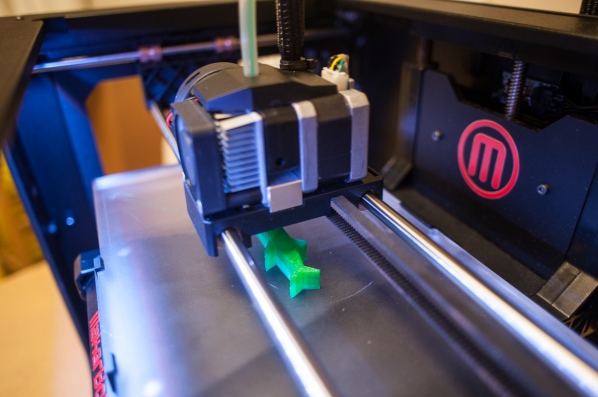
3D printer Replicator 2 (credit: MakerBot)

Will 3D printing make global supply chains unnecessary? That’s a real possibility, according to a recent report from Transport Intelligence, Smart Planet reports.

3D printing (or “additive manufacturing,” as it’s called in industrial circles) takes offshore manufacturing and brings it back close to the consumer. It has enormous potential to shift the trade balance. Goods will be cheaper to reproduce within the domestic market, versus manufacturing and then shipping them from a distant low-wage country.

The report (open access PDF), authored by John Manners-Bell of Transport Intelligence and Ken Lyon of Virtual-Partners Ltd., points to the growing role of automation in production resulting from 3D printing:

New technologies which are currently being developed could revolutionize production techniques, resulting in a significant proportion of manufacturing becoming automated and removing reliance on large and costly work forces. This in turn could lead to a reversal of the trend of globalization which has characterized industry and consumption over the last few decades, itself predicated on the trade-off between transportation and labor costs.

Companies may gradually move away from long-distance production as it gets cheaper to mass-produce at home. “There is obviously an enormous leap between a manufacturing process which can presently produce one-offs and one that can replace large scale manufacturing,” they say. “However, in theory, there is no reason why advances in technology could not increase the speed of production and reduce unit costs.”

The report adds that 3D printing “is already very good at producing products (even with moving parts) which previously would have required the assembly of multiple components,” and that by “eliminating the assembly phase there will be huge savings for the manufacturer in terms of labor costs.” 3D printing-based production could also reduce or eliminate storage, handling and distribution costs.

Eventually, products may even be produced right in consumers’ homes, reducing what was a series of supply-chain interactions to a software-based transaction.

Megaupload Renews Request For Criminal Charges To Be Temporarily Dismissed; Reminds Judge Of Earlier Request

When we wrote about the US judge in the Megaupload case siding with the US government in saying that, even without being able to technically serve the company (since it has no presence in the US), the criminal case could continue, we assumed that Megaupload would appeal. But even before appealing, the company is asking the judge to reconsider, based on an earlier request and the judge's own comments. The issue is that the judge's ruling only focused on whether or not the charges against Megaupload (but not the individuals charged in connection with the company) should be permanently dropped over the lack of service (in legal terms, it would be about having the charges dismissed "with prejudice"). However, the judge did note that perhaps it would make sense for the charges to be dropped without prejudice -- meaning that they would be dropped temporarily -- until such time as Kim Dotcom was extradited to the US, and could then be served as an "alter ego" for the company itself. The judge did not rule on that, however, since (he claimed) Megaupload had not asked for such a temporary dismissal. 

In response, however, Megaupload quickly filed a motion reminding the judge that they had, in fact, suggested dismissal without prejudice back in July, quoting the transcript during oral arguments, which also points out why due process suggests this is the only proper result for a company that has effectively been killed and has no recourse since it hasn't truly been charged yet:

THE COURT: Well, that—can I require them to serve the company on any particular date? There's no date in the rule—there appears to be no statutory limitation, and I understand your due process argument. So I—what if I, you know, would start with a premise that I don't control when the Government decides to serve the company. Where do we go from there? 

MR. BURCK: Well, Your Honor, we would submit that if the Court were ruling—going in that direction as a reasoning matter, that the appropriate result would be to dismiss the indictment without prejudice. 

Because the company, again, has already suffered all the consequences of a criminal prosecution, so the—even if there's a trial and the company is acquitted and the individuals are acquitted, of course the company is still done. 

So, we think that the due process claims trump all the other issues, and we think that if the Court were so inclined, that the Government should take certain steps in order to effectuate service, then—or if the extradition proceedings would be the relevant time line for that, again, the company should have an opportunity during that period of time to try to rehabilitate itself, because there isn't currently a criminal case that is sufficient for purposes of service and they've suffered massive harm. 

So, of course, that would not be our preference, and we do think that the Supreme Court has said you can't change the rules of service, et cetera, but the—that’s all in our brief—but we do think that the alternative would be dismissal without prejudice, allow the Government at the appropriate time to then supercede the indictment again, add the corporation into the indictment. 

And at that point, a year down the road, two years, however long it takes and wherever the MLAT process or the extradition process takes, at that point we could have this argument as to specific individuals, corporations, entities. But, in the meantime, having the company subject to the burden of a—the incredible burden of a criminal prosecution with no ability to defend itself and no service is an extraordinary result and one that is unprecedented.

In other words, Megaupload is saying dismiss this case until Dotcom is extradited, at which point (if he's ever extradited) then the company can be charged. But in the meantime, it's only fair to not have the company held back -- and the company did make that suggestion many months ago, contrary to the judge's suggestion otherwise.

Romney Strives to Stand Apart in Global Policy

Mitt Romney intensified his efforts Monday to draw a sharp contrast with President Obama on national security in the presidential campaign’s closing stages, portraying Mr. Obama as having mishandled the tumult in the Arab world and having left the nation exposed to a terrorist attack in Libya.

In a speech he gave at the Virginia Military Institute, Mr. Romney declared that “hope is not a strategy” for dealing with the rise of Islamist governments in the Middle East or an Iran racing toward the capability to build a nuclear weapon, according to excerpts released by his campaign.

The essence of Mr. Romney’s argument is that he would take the United States back to an earlier era, one that would result, as his young foreign policy director, Alex Wong, told reporters on Sunday, in “the restoration of a strategy that served us well for 70 years.”

But beyond his critique of Mr. Obama as failing to project American strength abroad, Mr. Romney has yet to fill in many of the details of how he would conduct policy toward the rest of the world, or to resolve deep ideological rifts within the Republican Party and his own foreign policy team. It is a disparate and politely fractious team of advisers that includes warring tribes of neoconservatives, traditional strong-defense conservatives and a band of self-described “realists” who believe there are limits to the degree the United States can impose its will.

Each group is vying to shape Mr. Romney’s views, usually through policy papers that many of the advisers wonder if he is reading. Indeed, in a campaign that has been so intensely focused on economic issues, some of these advisers, in interviews over the past two weeks in which most insisted on anonymity, say they have engaged with him so little on issues of national security that they are uncertain what camp he would fall into, and are uncertain themselves about how he would govern.

“Would he take the lead in bombing Iran if the mullahs were getting too close to a bomb, or just back up the Israelis?” one of his senior advisers asked last week. “Would he push for peace with the Palestinians, or just live with the status quo? He’s left himself a lot of wiggle room.”

In his remarks, Mr. Romney addressed the Palestinian issue, saying, “I will recommit America to the goal of a democratic, prosperous Palestinian state living side by side in peace and security with the Jewish state of Israel.” And he faulted Mr. Obama for failing to deliver on that front.

But while the theme Mr. Romney hit the hardest in his speech at V.M.I. — that the Obama era has been one marked by “weakness” and the abandonment of allies — has political appeal, the specific descriptions of what Mr. Romney would do, on issues like drawing red lines forIran’s nuclear program and threatening to cut off military aid to difficult allies like Pakistan or Egypt if they veer away from American interests, sound at times quite close to Mr. Obama’s approach.

And the speech appeared to glide past positions Mr. Romney himself took more than a year ago, when he voiced opposition to expanding the intervention in Libya to hunt down Col. Muammar el-Qaddafi with what he termed insufficient resources. He called it “mission creep and mission muddle,” though within months Mr. Qaddafi was gone. And last spring, Mr. Romney was caught on tape telling donors he believed there was “just no way” a two-state solution to the Israeli-Palestinian conflict could work.

Mr. Romney’s Monday speech called vaguely for support of Libya’s “efforts to forge a lasting government” and to pursue the “terrorists who attacked our consulate in Benghazi and killed Americans.” And he said he would “recommit America to the goal of a democratic, prosperous Palestinian state living side by side in peace and security” with Israel. But he did not say what resources he would devote to those tasks.

Terreform propose an alternative masterplan of New York

Cities are in crisis. The global urban population is growing at the rate of one million people every week. The characteristic response to this has been the hydra of megacities and sprawl, forms that have already fallen over the edge of apraxia, dysfunctional both physically and socially.

New York City (Steady) State (NYCSS) proposes an alternative masterplan for the city, predicated on the idea that it is possible for the city to become completely self-sufficient, its ecological footprint co-terminus with its political boundaries. NYCSS examines the outer limits of the autarkic city, focusing on food, waste, energy, movement, manufacture, building, water, air and climate as defining systems that will, in turn, yield the anatomical diagram of self-reliance. Based on a rigorous process of research and analysis, NYCSS has made a series of calculations on both the demand and the supply of various functions of the city, and investigated a series of formal solutions that begin at the margin and attempt to harmonize autonomy and rationality.

NYCSS relies on the tenets of sustainability to guide its course, but unlike similar projects, demonstrates how this conceptual structure, balancing environment, economy and equity, manifests physically in practice. It is the mission of NYCSS to inform policy-makers and the citizenry of the unique opportunities that alternative architectural typologies, urban forms, and political-economic frameworks can have on city life.

ReDigi

ReDigi is a free cloud service that allows you to store, stream, buy, and sell your legally purchased pre-owned digital music.

Up ↑